

How much spacing should there be between brackets?
Posted on: 05/06/2025
When it comes to how much spacing there should be between brackets, the general rule of thumb is every 300mm to 400mm for horizontal runs, and 500mm to 600mm for vertical runs, but this depends on the type and weight of the cable.
Think of it like hanging up washing on a line, if the pegs are too far apart, you’ll end up with sagging in all the wrong places.
Think of it like hanging up washing on a line, if the pegs are too far apart, you’ll end up with sagging in all the wrong places.

Why Correct Bracket Spacing Matters
Proper spacing during cable bracket installation ensures cables remain neat, protected, and compliant with regulations like BS 7671 (IET Wiring Regulations).
Not only does this reduce strain on the cable itself, but it also helps prevent long-term wear, especially when routing cables in ceiling voids or securing them in wall cavities.
Factors That Affect Bracket Spacing
There’s no one size fits all answer, but consider:
Cable weight: Heavier armoured or multi-core cables need more support.
Cable type: Data cables are more lightweight than power cables, so they can be spaced a little further apart, but don’t get too excited.
Environment: Installations in ceilings or tight wall spaces often need brackets placed more frequently to avoid sag or kinks.
Cable orientation: Vertical runs tend to be more forgiving, while horizontal runs need tighter spacing to avoid droop.
Material and type of bracket: Flexible clips or steel brackets each have their own strength and limitations.
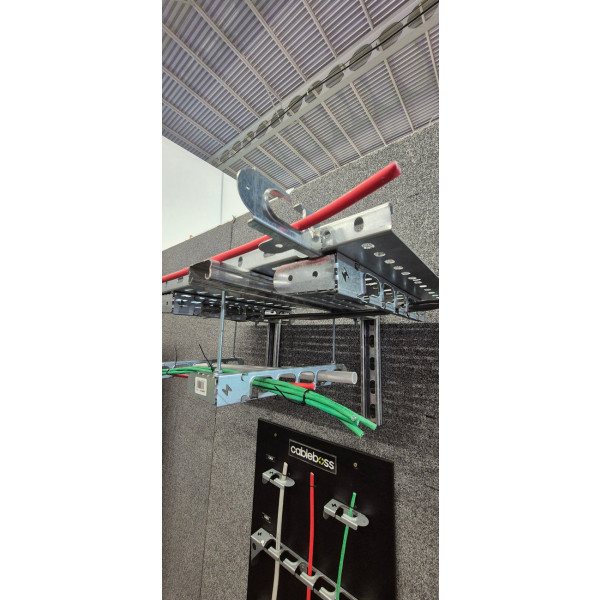
Installing Cable Brackets in Ceilings or Walls
When mounting cable brackets in ceilings, always secure them into solid structures like joists or battens. For securing cables in walls, use cavity fixings or purpose-designed cable supports that won’t pull loose over time. And if you’re working in a space tighter than a budget at the end of the financial year, go with low-profile cable clips or bendable trunking systems that conform to your route.
Common Mistakes to Avoid
Leaving too much distance between brackets—especially with heavier bundles.
Using adhesive clips alone on ceilings (gravity is undefeated).
Ignoring changes in direction—support those corners.
Over tightening brackets and damaging cable sheaths.
Cable Support in Wall Cavities
Wall cavities are tricky. It's easy to forget that cables need as much support inside the wall as outside. Use drop rods or cavity specific cable fixings and avoid letting the cable rest unsupported between entry and exit points. Always think long term, what holds now might not hold after a few temperature cycles or a bit of building movement.

FAQs
What’s the standard spacing for cable brackets?
For horizontal cable runs, aim for 300mm–400mm spacing. For vertical runs, 500mm–600mm usually does the trick. Heavier cables need closer support.
Can I use cable clips instead of brackets?
Yes, for smaller or individual cables. But for bundles, trunking, or installations in ceilings, brackets provide stronger and more reliable support.
How do I install cable brackets in tight spaces?
Use compact brackets, flexible conduit, or pre-assembled support frames. Consider your access and tools beforehand, it can save a lot of awkward wriggling.
Is there a difference in spacing for indoor vs outdoor cable runs?
Yes. Outdoor environments introduce factors like temperature swings and moisture, which means tighter spacing is often safer to reduce sag and strain.
What happens if I space the brackets too far apart?
Cables may sag, strain at connections, or become a safety hazard. Over time, this can lead to signal degradation or even failure.
style="max-width:100%; max-height:100%; width:230px;height:72px" data-hubspot-wrapper-cta-id="204423334079">
 onerror="this.style.display='none'" />
 onerror="this.style.display='none'" />
 Related Products